
Smart money concepts, examined
SMC and ICT are the most talked-about ideas in Arabic trading right now. Some of it is a genuinely useful way to read a chart. Some of it cannot be tested at all.
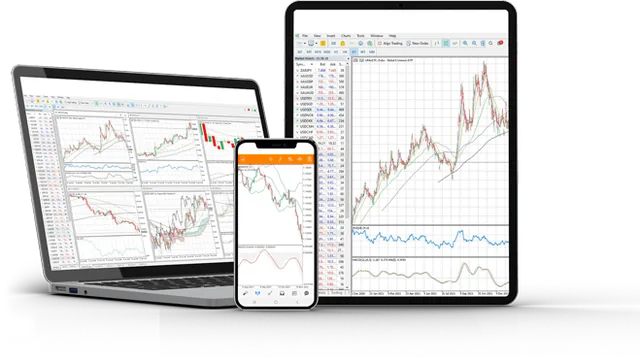
Both platforms
Live chart, on the phone you already have


FSA-licensed broker · Licence SD133
The idea underneath it
The claim is that large institutional orders cannot be filled all at once, so they have to be worked into the market where enough opposing orders exist — which is where retail stop losses cluster, just beyond obvious highs and lows.
That part is not controversial. Anyone moving size does have to find liquidity, and stops do cluster at obvious levels. Price sweeping just past a visible high and then reversing is a real, observable pattern, and it has a plausible mechanical explanation.
So the useful core of SMC is this: obvious levels attract stops, and stops are fuel. That reframes a level from "support that should hold" into "a pool of orders somebody may want to reach". Genuinely a better mental model.
Obvious levels attract stops. Stops are fuel. That much is real and worth knowing.
The vocabulary, in plain terms
| Term | What it means |
|---|---|
| Liquidity sweep | Price pushes past an obvious high or low, triggering stops, then reverses |
| Order block | The last candle before a strong move — treated as where large orders sat |
| Fair value gap | A gap between candle wicks, treated as unfinished business price may return to |
| Break of structure | Price making a higher high or lower low, read as a change in direction |
| Premium / discount | Upper or lower half of a range — where you would rather sell or buy |
Where it stops being testable
Here is the honest problem, and it is worth understanding before you pay anyone for a course on this.
There are usually several order blocks and several fair value gaps visible on any chart. After the move, whichever one price respected is the one that gets pointed at. The ones it ignored are explained away — wrong timeframe, not a real order block, the higher timeframe overrode it. A framework that can explain every outcome after the fact predicts none of them in advance.
That does not make it worthless. It makes it a lens rather than a system. Used as a lens — where is liquidity, which side is trapped, where would I be wrong — it is genuinely good. Used as a promise that price must return to a specific gap, it is astrology with better vocabulary.
If you want to trade it
- Mark levels before the session, not during. Deciding what counts as an order block after the move is how the framework fools you.
- Write the invalidation first. If you cannot say what price would prove the idea wrong, you do not have a trade.
- Test it forward. The charts in every course are chosen because they worked.
- Do not raise size because the setup looks clean. Conviction is not an edge — it is the feeling that precedes most large losses.
Common questions
Is SMC or ICT better than classic technical analysis?
It is a different lens on the same chart. The liquidity idea is a genuinely better mental model than "support should hold"; the rest is no more predictive than indicators.
What is an order block?
The last candle before a strong move, treated as where large orders were placed. Several are usually visible, and which one "worked" is only clear afterwards.
Do fair value gaps always get filled?
No. Many do, many do not, and the ones that do are the ones shown in courses.
Should I pay for an SMC course?
You do not need to. Every concept is explained free in many places, and nobody can sell you certainty about a market.
Can I trade these ideas on MT4 or MT5?
Yes — they are ways of reading the chart, not tools. Nothing extra needs installing.