
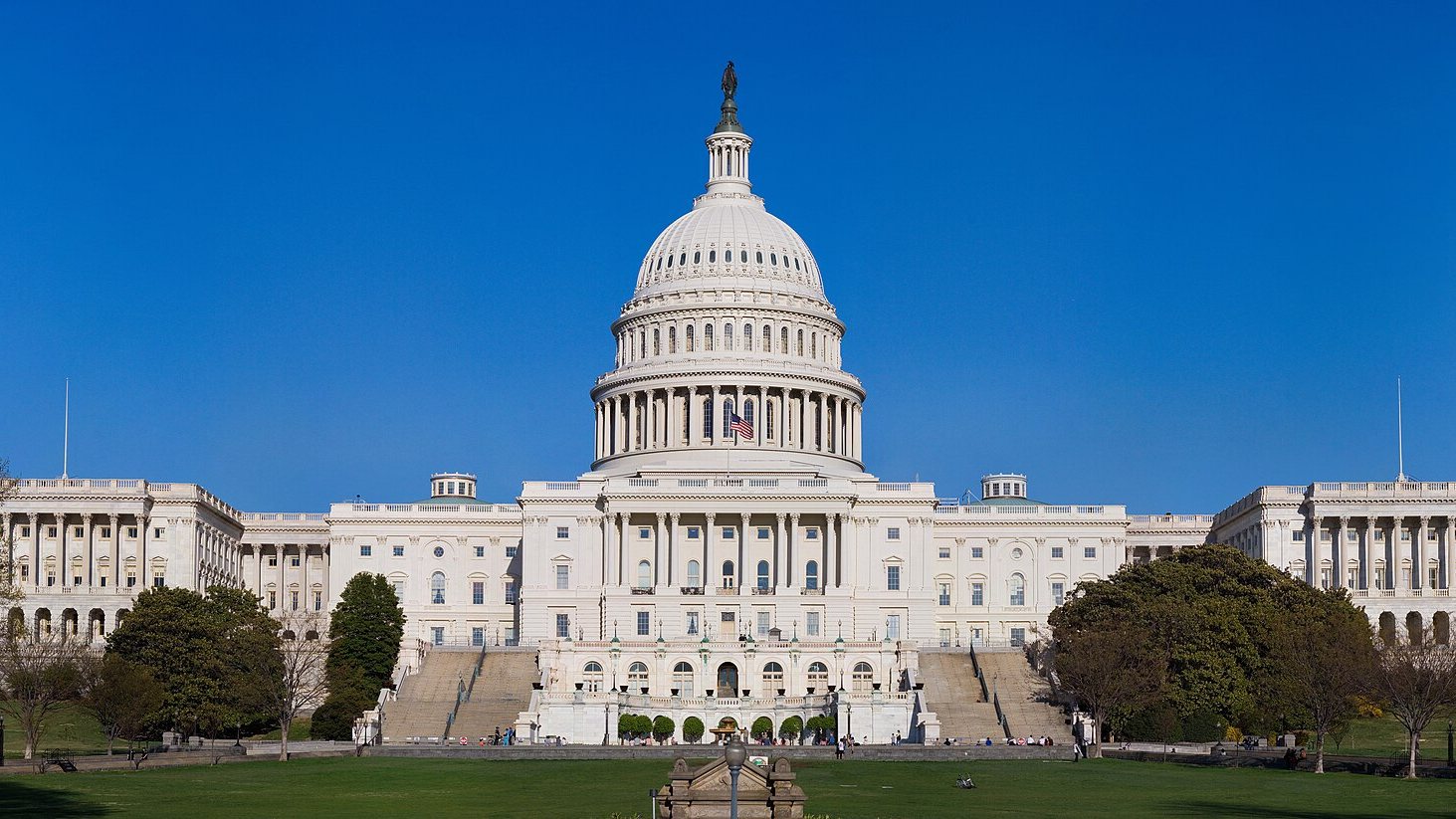
Americans vote on Tuesday 3 November in midterm elections that decide control of Congress for the last two years of President Donald Trump's term. All 435 seats in the House of Representatives and 35 of the 100 Senate seats are on the ballot, and Republicans control both chambers today. Polls give Democrats a national lead of about 8 to 10 points; the House is widely seen as likely to change hands, while the Senate is a closer call. The first polls close at 02:00 Mecca time on Wednesday, but full control of Congress may not be known for days. On our MT5 feed the S&P 500 ended the week at 7,587.45.
What is on the ballot
The midterms fall halfway through a president's four-year term. This time voters choose:
- The House: all 435 seats. Republicans hold 218 and Democrats 214, with one independent who sits with the Republicans and two seats vacant. Democrats need a net gain of three seats to take control.
- The Senate: 35 seats, 33 regular races plus special elections in Ohio and Florida. Republicans are defending 22 of them and Democrats 13. The Senate is 53 to 47 today; Democrats need a net gain of four seats, because a 50-50 tie is broken by Vice President JD Vance.
- Governors: 36 states elect a governor.
Where the race stands
National polls give Democrats a lead of about 8 to 10 points when voters are asked which party they want in Congress. Forecasters and prediction markets see the House as likely to switch to the Democrats, with odds above 90%. The Senate is less certain: estimates for a Democratic majority range from about even to roughly 80%, and seven races are within the polls' margin of error.
Polls can be wrong, and turnout in a midterm is lower and harder to predict than in a presidential year. Treat these numbers as the market's starting point, not as a result.
When the results come in (Mecca time)
Counting starts as polls close, from east to west:
The first polls close in the eastern United States and early counts begin.
Polls close in most of the closely fought states; the first trends usually appear in this window.
The last polls close, in Alaska.
Close races can take days to call. In 2022 control of the Senate was clear four days after the vote and the House eight days after. California and Alaska count slowly, and a Georgia runoff, if needed, would be held on 1 December.
What history says about stocks
Since 1950 the S&P 500 has been higher 12 months after every one of the 19 midterm elections. Measured from the end of October, the average gain was about 16.6% and the weakest about 3%. The pattern held after the 2022 vote, with a gain of about 8.3%. Over a longer record going back to 1874, stocks rose in 32 of 38 cases, so it is a strong tendency, not a rule.
The run-up is often bumpy: since 1970, typical volatility in midterm years has been about 16%, against 13% in other years. On our MT5 feed the S&P 500 is at 7,587.45 (−1.04% over five days), after Friday's tech-led sell-off.
Three scenarios for markets
Strategists broadly sketch three outcomes. These are views, not forecasts:
- Democrats win both chambers: seen as the least friendly outcome for banks and industrial companies, because of the prospect of higher taxes and more regulation. Some strategists warn stocks could fall by 10% or more; views on Treasury yields are split.
- A split Congress: Democrats take the House while Republicans keep the Senate. Gridlock means few new laws, which markets have usually lived with comfortably.
- Republicans keep both chambers: seen as positive for banks, defence companies and smaller US firms, with policy staying on its current path.
The dollar and gold
There is no reliable long-run pattern for the dollar or gold around midterms. What moves them now is US interest rates: the Federal Reserve held rates at 3.75–4.00% on 28 October, markets put the chance of a hike at its next decision on 9 December at about 70–75%, and the 10-year Treasury yield is near 4.9%.
The election works through that channel. Strategists say a result that markets read as bigger budget deficits could push yields up, while gridlock usually brings fewer surprises. Gold fell −3.63% on Friday to $3,875.05 as hike bets rose, and the dollar index moved +0.22% over five days.
Issues markets are watching
- Tariffs: Democratic plans assume many tariffs would be removed, but analysts say they are hard to undo without the White House.
- Deficits and debt: one estimate puts Democratic plans at about $5 trillion of extra borrowing over ten years, and a fight over the US debt ceiling is due in 2027.
- The Fed's independence: some strategists say a Democratic Senate could ease worries about political pressure on the central bank.
- Energy: US petrol prices above $4 a gallon are a campaign issue.
- Crypto rules: a bill on crypto market structure stalled after a 49–50 vote in the Senate; the new Congress will decide its fate.
Trading the election at TNFX
- The first big moves usually come in the Asian session on Wednesday, as early results arrive between 02:00 and 05:00 Mecca time.
- Spreads can widen and prices can jump around results: use a stop-loss and smaller positions.
- Do not trade on the first headline. Close races can take days to call.
- The S&P 500 (US500), Nasdaq 100 (USTEC), the dollar and gold are all on TNFX MT4 and MT5.
Trade the election on MT5
Open a real account in two minutes, or practise first on a free demo account with virtual money.
Common questions
When are the US midterm elections in 2026?
Tuesday 3 November 2026. The first polls close at 02:00 Mecca time on Wednesday 4 November, and the last, in Alaska, at 09:00 Mecca time.
What is at stake in the 2026 midterms?
All 435 seats in the House of Representatives, 35 of the 100 Senate seats and 36 governorships. Republicans control both the House and the Senate today.
Who is expected to win the US midterms?
Polls give Democrats a national lead of about 8 to 10 points, and the House is widely seen as likely to switch to them. Control of the Senate is closer. Polls can be wrong, so treat this as expectations, not results.
How do stocks usually perform after midterm elections?
Since 1950 the S&P 500 has been higher 12 months after all 19 midterm elections, with an average gain of about 16.6% from the end of October. Past performance does not guarantee future results.
How could the US election affect the dollar and gold?
There is no reliable historical pattern. Both are driven mainly by US interest rates now: markets price about a 70–75% chance of a Fed hike on 9 December. A result seen as adding to deficits could lift yields, while gridlock usually brings fewer surprises.
When will we know who controls Congress?
Sometimes on election night, but close races can take days. In 2022 the Senate was decided four days after the vote and the House eight days after.