
Stop loss and take profit
A stop is not a prediction of how far price will go against you. It is the point at which you accept the trade was wrong. Those are different things, and confusing them is expensive.
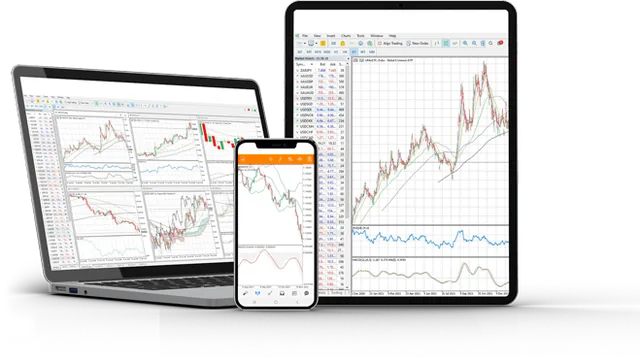
Both platforms
Live chart, on the phone you already have


FSA-licensed broker · Licence SD133
Where a stop actually belongs
Put it at the price that proves your reason for entering was wrong. If you bought because a level held, the stop goes below that level — because if price is through it, the reason has gone.
This is the opposite of the common approach, which is to place the stop at whatever loss feels tolerable. That number has nothing to do with the market and everything to do with your position being too big.
The sequence matters: find the invalidation point first, then size the position so that reaching it costs an acceptable amount. Sizing follows the stop, never the other way round.
Why your stop keeps getting hit
Because it is where everyone else put theirs. Stops cluster immediately below obvious lows and above obvious highs, and those clusters are pools of resting orders. Price reaching in, filling them and reversing is not a conspiracy — it is liquidity behaving as liquidity does.
The practical answer is to place stops beyond the obvious level rather than exactly on it, and to accept a slightly wider stop with a smaller position rather than a tight stop with a large one.
A stop taken by genuine movement is the system working. A stop taken by a two-pip spike that immediately reverses usually means it was sitting in the crowd.
What a stop does and does not guarantee
A stop loss guarantees that your order becomes a market order at that price. It does not guarantee the price you get.
In normal conditions the difference is negligible. Around a major data release, or at the Sunday open after weekend news, liquidity thins and the fill can be materially worse than the level you set. That gap is slippage, and it is real.
This is why traders who hold through high-impact releases size smaller than usual, or step aside entirely.
Take profit, and the harder problem
Exits are harder than entries because both choices feel wrong. Close early and you watch it run without you; hold on and you watch a winner turn.
A fixed target set in advance solves the decision by removing it. A trailing stop keeps you in a trend but gives back some of the move by design. Neither is superior — what matters is choosing before the trade and not renegotiating during it.
The one approach that reliably fails is having no exit plan and deciding while the position is open, because the decision then gets made by whichever emotion is loudest.
Moving a stop
Moving a stop closer to lock in profit is risk management. Moving it further away because price is approaching is not — it converts a planned loss into an unlimited one, and it is the single most account-destroying habit in trading.
The rule that works is mechanical: the stop may move in the direction of the trade, never against it. Decided in advance, it needs no willpower in the moment.
Common questions
Where should I place my stop loss?
At the price that invalidates your reason for the trade, not at a loss amount that feels comfortable. Then size the position so reaching it costs an acceptable sum.
Why does price hit my stop and then reverse?
Stops cluster just beyond obvious highs and lows, forming pools of orders price tends to reach into. Place stops beyond the obvious level rather than exactly on it.
Does a stop loss guarantee my exit price?
No. It guarantees your order becomes a market order. During news or at the Sunday open the fill can be worse — that is slippage.
Should I use a trailing stop?
It suits trend-following and by design gives back part of the move. A fixed target suits range trading. Choose before entering, not during.
Can I move my stop loss?
Toward the trade to protect profit, yes. Away from it because price is approaching, no — that is how planned losses become unlimited ones.
What risk-to-reward should I aim for?
1:2 is a common default: it means you can be right less than half the time and still profit. The target must be realistic for the market's actual range.