
Trading the US indices from Iraq
The Dow and the Nasdaq are the two instruments Iraqi clients ask about most after gold. They behave differently from currency pairs, and the differences cost money if you meet them by surprise.
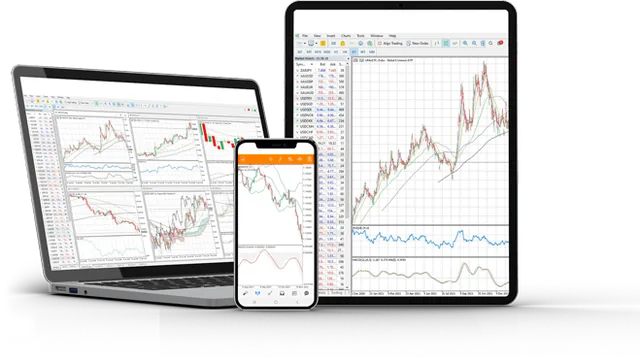
Both platforms
Live chart, on the phone you already have


FSA-licensed broker · Licence SD133
What you are actually trading
An index is a basket, not a company. DJ30 is one price representing thirty large US companies at once; USTEC tracks a hundred, weighted toward technology. You are trading the price of that basket through a CFD — you never own a share and no dividend is delivered to you.
The practical effect is that a single company's news rarely moves an index much, while anything touching the whole economy — an interest-rate decision, an inflation print, employment data — moves all of them together.
| Symbol | What it tracks | Most active hours (Baghdad) |
|---|---|---|
| DJ30 | 30 large US industrials | 16:30 – 23:00 |
| US500 | 500 large US companies | 16:30 – 23:00 |
| USTEC | 100 largest Nasdaq names, tech-heavy | 16:30 – 23:00 |
| GER30 / UK100 | German and UK large caps | 10:00 – 18:30 |
| JPN225 | Japanese large caps | 02:00 – 08:00 |
Three things that catch people out
They gap. The underlying cash market opens and closes, so news arriving overnight shows up as a jump rather than a move you could trade through. A stop loss does not protect you at a price the market never traded at — it fills at the next available price, which can be well past your level.
The first half hour of the US session sets much of the day. That is late afternoon in Baghdad, which is convenient — but it is also where the widest ranges and the fastest reversals live. Convenient is not the same as easy.
Point value is not intuitive. An index moving a hundred points sounds small next to a currency pair moving a hundred pips. It is not. Work out what one point is worth on your position size before you open it.
Leverage on indices is capped lower than on FX
Maximum leverage on an index is 1:100 here, regardless of what your account is set to. The leverage actually applied is always the lower of your account's setting and the instrument's cap — so a 1:1000 account trading DJ30 is margined at 1:100.
That is not a restriction invented to annoy you. Indices gap, and a gap on a highly leveraged position is how accounts go negative rather than merely to zero.
The leverage applied is the lower of your account and the instrument. A 1:1000 account trades DJ30 at 1:100.
If you are coming from gold
Most Iraqi traders arrive at indices from XAUUSD, and the instinct is to size the same way. Do the arithmetic first: gold and an index move a very different number of units per day, and the same lot size carries a different amount of risk on each.
The habit worth keeping from gold is the one about scheduled events. Indices respond to the US data calendar the way gold does — inflation, employment, central-bank decisions. Knowing when they land is not a strategy, but not knowing is a way to be surprised on a timetable.
Common questions
Can I trade the Dow and Nasdaq from Iraq?
Yes. DJ30, US500 and USTEC are all available on MT4 and MT5, alongside German, UK and Japanese indices.
What is the maximum leverage on an index?
1:100. If your account leverage is higher, the instrument cap applies instead — the lower of the two is always used.
Why did my stop loss fill far from where I set it?
Indices gap when the underlying cash market is closed. A stop cannot fill at a price the market never traded at, so it executes at the next available price.
When is the best time to trade US indices from Iraq?
The US session, from about 16:30 Baghdad time. The first half hour carries the widest ranges — the most opportunity and the most risk.
Do I receive dividends?
No. Index CFDs track price movement; you do not own the underlying shares.