Forex trading from Nigeria: what it costs to start
The question Nigerians put to Google about forex more than any other is whether ₦5,000 is enough to start. At ₦1,370 to the dollar — the parallel rate on 3 October 2026 — that is $3.65, and the straight answer is no, not here and not at any broker we are aware of. The lowest minimum on this site is $5. Starting with that arithmetic is more use to you than starting with a pitch.
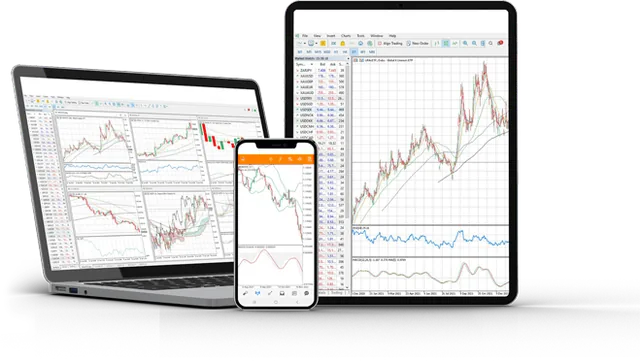
Both platforms
Live chart, on the phone you already have


FSA-licensed broker · Licence SD133
₦5,000, ₦1,000, and the six real minimums
There are exactly six ways to fund an account here, none of them local: the Ovadot wallet from $5, card from $10, USDT from $10, Payeer from $10, Ptop from $10, and an international bank wire from $100. There is no naira rail and no Nigerian processor.
Nigeria has two rates: about ₦1,327 official and ₦1,363–1,372 parallel in early October 2026. This page uses ₦1,370, the rate you face buying USDT or spending on a card — check today's number. The minimums are then about ₦6,850, ₦13,700 and ₦137,000, so ₦5,000 is $3.65 and clears none of them, and ₦1,000 is 73 cents.
There is no welcome bonus and no no-deposit bonus, so nothing turns ₦5,000 into a funded account. What ₦5,000 buys is time: the demo is free and runs on the MT4 and MT5 apps on your phone.
Nigeria is writing its first retail FX rulebook
The SEC's proposed rules on online forex trading and contracts for difference set minimum paid-up capital at ₦2 billion for a broker that passes client orders straight through, ₦3 billion for one that takes the other side as principal, and ₦5 billion for a technology or platform provider, with ₦150 million for a corporate introducing broker and ₦30 million for an individual one. A minimum level of Nigerian ownership is also proposed.
They explicitly reach offshore firms targeting Nigerian residents. If adopted, existing operators get three months to apply and six to comply; the draft goes to the industry at the Lagos Finance Summit in mid-October 2026.
Until something is adopted, the SEC's standing position is that retail online forex is not a registered activity and that participants take part at their own risk — the regulator's framing, not ours.
We are not SEC-registered, and nobody is CBN-licensed for retail forex
TNFX Ltd holds one financial licence: SD133, Securities Dealer, from the Financial Services Authority of Seychelles. We are not registered with the Nigerian SEC, we hold no authorisation from the Central Bank of Nigeria, and we are not licensed by the FCA, ASIC or CySEC. You would be trading with an offshore broker, without the local supervision or local recourse a locally licensed firm carries.
One test follows from that, and it is useful wherever you end up opening an account. The CBN licenses authorised dealers for the interbank foreign exchange market; it does not license retail CFD brokers at all. Any broker claiming CBN licensing for retail forex is telling you something that cannot be true, and that single question will save you from a fair number of them.
Why your naira card deposit may be declined before it reaches us
Nigerian banks set their own international spending limits on naira cards, and the spread between them is enormous. Through 2026, as dollar liquidity in the official market improved, several of the large banks raised those limits sharply, while others still cap international spend at roughly a hundred dollars a month.
So a card deposit that fails has usually been stopped by your own issuer, not by us, and the fix is your bank rather than our payment page. A domiciliary account and an international wire sidestep the limit, at the cost of one to three business days. USDT avoids the banking question altogether, which is why many clients here use it.
Withdrawals are paid only to a method in your own name, never to a third party, so fund through the route you actually want to be paid back through.
Clocks, cable distance, and what we compete on
Lagos keeps UTC+1, while the platform clock is UTC+3, the same as Mecca — so a candle stamped 15:00 on the platform opened at 13:00 in Lagos. The London–New York overlap, the deepest liquidity of the day, runs 14:00–18:00 Lagos time.
Positions held past the daily close accrue overnight financing. Swap-free status is available on request on any account type, but applied to your individual account rather than switched on by default: on a swap-free account nothing is charged overnight and nothing is earned, and on an ordinary account it is charged normally. Confirm yours is active before holding overnight.
MetaTrader 4 and MetaTrader 5 run on our London servers at Equinix LD4. Lagos to London is a long path, so a latency-sensitive expert advisor belongs on a VPS near the server. Orders are passed through to liquidity providers.
Check before you deposit from Nigeria
The five facts to verify before sending money — every row is checkable, and the licence row links to the regulator's own register.
| Licence | TNFX Ltd — Securities Dealer licence SD133, Financial Services Authority of Seychelles. Verify on the FSA register. TNFX holds no licence from any authority in Nigeria. |
| Deposit from Nigeria | card (Visa/Mastercard) · USDT (TRC-20) · Ovadot wallet · Payeer · Ptop · international bank wire (from $100) |
| Minimum first deposit | $100 on Standard, Cent and Turbo (≈ ₦ 137,000 at the mid-October 2026 rate, check your bank); $500 on Zero. Card and wallet deposits from $5–10. |
| Withdrawal | Same routes. Minimum $50. USDT and wallet payouts usually within hours; bank wire 1–3 business days. |
| Talk to a person | Live chat on this page, 24 hours a day, six days a week (closed Saturday) · Dubai office +971 4 552 6527 · [email protected] |
Common questions
Can I start forex trading with 5000 Naira?
No. At ₦1,370 to the dollar, the parallel rate on 3 October 2026, ₦5,000 is $3.65 — and the lowest minimum here is $5 through the Ovadot wallet, about ₦6,850. Card, USDT, Payeer and Ptop start at $10, roughly ₦13,700, and a bank wire at $100, about ₦137,000. No bonus bridges the gap, so use the free demo until you have the deposit.
How much do I need to start forex trading in Naira?
Enough to clear a minimum and still size a position sensibly, and those are two different numbers. The minimum is $5, about ₦6,850 at ₦1,370. The real number comes from margin: one standard lot of EURUSD is 100,000 euro, so at 1:100 it needs 1,000 euro, which is $1,133.70 at EURUSD 1.1337 — roughly ₦1.55 million. The smallest 0.01 lot needs about $11.34.
Which forex brokers are trusted in Nigeria?
Nobody is locally licensed for retail forex yet, so trust has to be tested rather than taken. Check the licence number on the regulator's own register, not on the broker's website. Ask whether it claims a CBN licence for retail forex, which cannot exist. Ask how withdrawals are paid. We hold FSA Seychelles SD133 and no Nigerian registration — verify that yourself.
Which broker is licensed in Nigeria?
None, for retail forex, as things stand. The SEC's proposed rules of 1 September 2026 would create that licence and they are not in force. The CBN licenses authorised dealers for the interbank market, not retail CFD brokers. Any firm claiming a Nigerian retail forex licence today is describing something that does not exist yet, which is itself a useful warning.
How do I withdraw my money from forex?
You request it in the client area and it is paid back to a method in your own name, never to a friend, a relative or a company account. That is an anti-money-laundering requirement rather than a preference, so choose your deposit route with the withdrawal in mind. How long it takes depends on the route and on your own bank.
Is forex trading also gambling?
Mechanically it is not: the market is two-way, you choose your size, your stop and when to leave, and there are no fixed house odds against you. In practice it becomes gambling the moment you skip all three. Leverage is what makes the distinction bite, because it decides how many bad decisions your account can survive.
Is forex trading legal in Nigeria?
There is no retail forex licensing regime in force yet. The SEC published proposed rules for online forex and CFD trading on 1 September 2026 and they have not been adopted; its standing position has been that retail online forex is unregulated and that you take part at your own risk. Treat that as the state of play, not as legal advice from us.